

.webp)


Homebrewing Worlds in Dungeons & Dragons 5e
- Jan 23
- 16 min read
The practice of "homebrewing" the creation of custom campaign settings, mechanics, and narratives within the Dungeons & Dragons 5th Edition (5e) framework represents the pinnacle of the Dungeon Master’s craft. It is an undertaking that transforms a game moderator into a world architect, requiring a synthesis of geography, sociology, ludology, and narrative design. While published modules provide structure, a homebrew world offers the unique opportunity to tailor a reality specifically to the agency and backstories of the players at the table.
This report serves as an exhaustive analysis of the homebrewing process, designed for content creators and Dungeon Masters (DMs) seeking to elevate their craft. It dissects the structural methodologies of world creation (Top-Down, Bottom-Up, and Spiral), explores high-concept settings such as titan-corpse cosmologies and floating archipelagos, and details the integration of custom mechanical systems like faction renown and blood magic. By leveraging expert community discourse and game design theory, this document provides a definitive blueprint for constructing living, breathing worlds that avoid the pitfalls of "Worldbuilder’s Disease" and "Cultural Monoliths."

Structural Methodologies: The Geometry of Creation
The first decision a Dungeon Master makes is not about dragons or dungeons, but about the direction of their creative gaze. The community has crystallized around three primary architectural philosophies: the macro-lens of the Top-Down approach, the micro-lens of the Bottom-Up approach, and the dynamic fluidity of the Spiral Campaign method. Understanding the distinct advantages, risks, and best-use cases for each is a prerequisite for successful worldbuilding.
The Top-Down Approach: The Macro-Architect
The Top-Down methodology is the path of the historian and the cartographer. It initiates the creative process at the highest possible level of abstraction often at the scale of the cosmos itself before narrowing the focus to the specific locations where gameplay occurs.
The Theoretical Framework
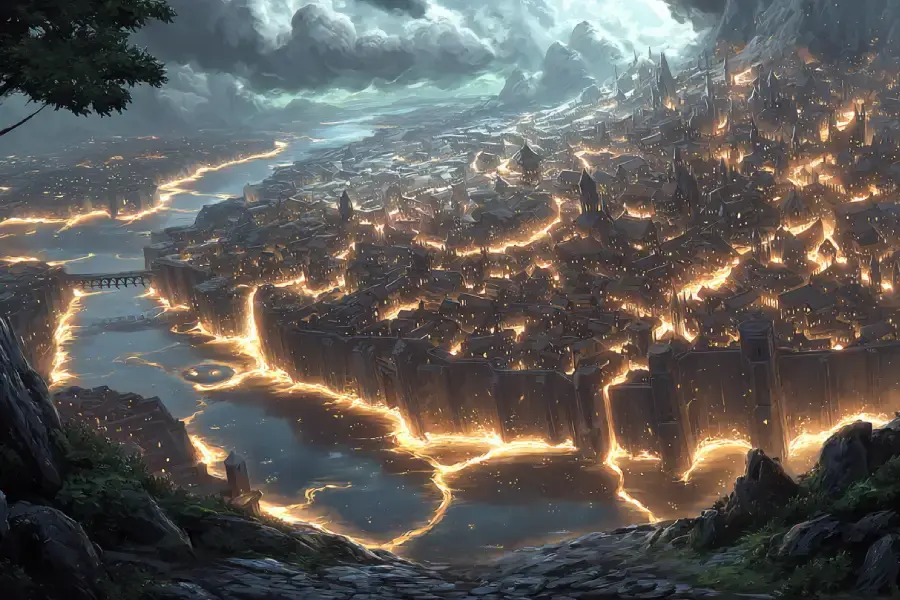
In this model, the creator acts as a deity. They establish the fundamental laws of the universe, the pantheons of gods, the arrangement of continents, and the broad strokes of millennia of history before a single non-player character (NPC) is named. This approach is particularly favored for high-fantasy settings where metaphysical truths define physical reality. As noted in community discussions, "anything related to the celestial bodies and divine or cosmic events... are the 'top' when it comes to world-building".
For example, if a world is built on the premise that magic is a finite resource draining the sun, this high-level fact acts as a gravitational center. It dictates the climate (cooling), the religion (sun-worship or sun-fear), the economy (wars over magical batteries), and the geography (civilizations huddling near geothermal vents). By establishing these "high-level specs" first dominant races, geographic regions, prominent religions, the DM creates a "common well" of lore that ensures consistency across the entire globe.
Internal Consistency and Logic
The primary strength of Top-Down design is coherence. Because the "rules of the world" are established a priori, every subsequent detail fits into a logical framework. When a player asks why a specific empire hates a specific god, the answer is rooted in a pre-written creation myth rather than an improvisation that might contradict future lore. It allows for complex geopolitical webs where the relationships between colonial provinces and imperial motherlands are defined by geography and resource distribution.
The Peril of "Worldbuilder's Disease"
However, the Top-Down method carries a significant risk known colloquially as "Worldbuilder's Disease" or "The Lonely Fun." This occurs when a DM spends hundreds of hours detailing distinct cultures, export tariffs, and dynastic lines for continents the players will never visit. A full world is dauntingly large, and the temptation to fill every hex on the map can lead to burnout before the first session begins. As one expert analogy suggests, "You don't start by painting and furnishing each room individually then connecting them together – instead, you create the structure first". The danger lies in never finishing the structure to let the residents (players) in.
The Bottom-Up Approach: The Local Gardener
Diametrically opposed to the macro-architect is the Bottom-Up approach. This method prioritizes the immediate, tangible experience of the players. It begins with a single location a village, a tavern, a dungeon and expands the world only as the players explore it.
The Fog of War as a Creative Tool
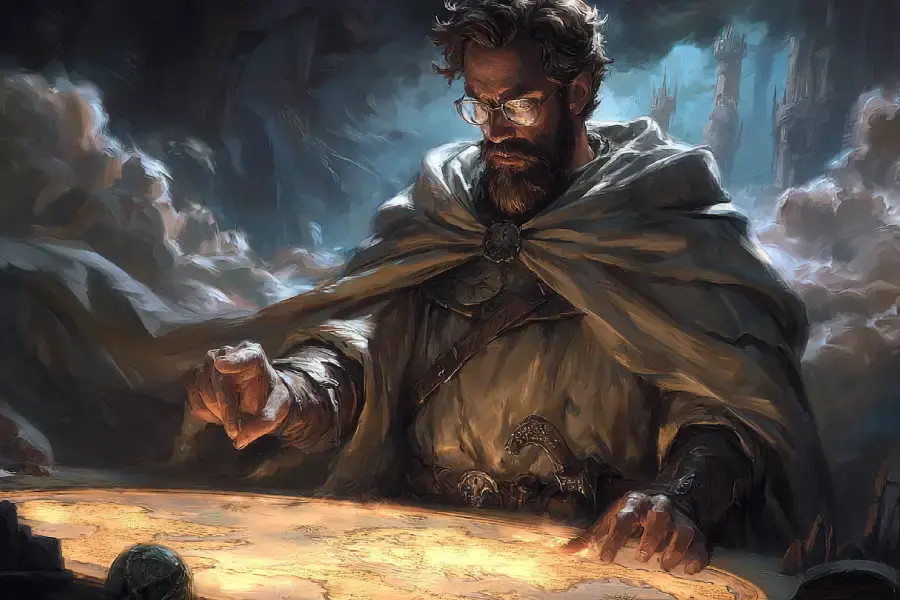
In a Bottom-Up world, everything outside the players' immediate perception exists in a state of quantum flux, often referred to as "GM and player fog of war". This allows the DM to tailor the world in real-time. If the players express a sudden interest in pirates, the DM can place a coastline just beyond the nearby forest, a geographical pivot that would be impossible if a rigid world map had already been drawn.
This method is highly efficient. The DM creates only what is necessary for the next session, adhering to the principle of "Just-in-Time" content delivery. It mimics the player’s perspective, starting zoomed in on the small details "How large is the town? How are the fields organized?" and zooming out only when necessary.
The Risk of the Patchwork Quilt
The disadvantage of Bottom-Up design is the potential for tonal and logical inconsistency. Without a guiding "world bible," a DM might create a horror-themed swamp next to a whimsical fey forest without a geographical or magical explanation for their proximity. This "patchwork" effect can strain the suspension of disbelief if the seams between different improvised ideas become visible. Furthermore, lacking a broader context can make it difficult to foreshadow epic threats, as the "villain behind the curtain" may not have been invented yet.
The Spiral Campaign: A Synthesis of Form
The "Spiral" method, championed by industry thought leaders like Mike Shea (Sly Flourish), represents the evolution of worldbuilding theory. It seeks to combine the consistency of Top-Down design with the efficiency of Bottom-Up execution, placing the player characters (PCs) at the epicenter of the creation process.
Character-Centric Gravity
The Spiral method dictates that the world should be built outward from the characters' backgrounds, motivations, and immediate goals. It begins with the question: "What do the characters know?". If a player creates a Cleric of the Sun God, the DM must then build the Sun God and the church hierarchy. If a player is a criminal, the DM builds the local thieves' guild. The world is literally generated by the players' choices during character creation.
The Spiraling Horizons
Development occurs in "horizons" or concentric rings:
The Immediate Horizon: The location of the first session, the immediate villains, and the NPCs relevant right now.
The Local Horizon: The surrounding region, offering three distinct adventure locations (e.g., a ruined watchtower, a goblin cave, a haunted forest).
The Distant Horizon: Vague rumors of the capital city or the dark lord, left undefined until the players move toward them.
The Six Truths
To maintain the thematic cohesion of a Top-Down world without the workload, the Spiral method utilizes "The Six Truths" (or sometimes ten). These are short, punchy sentences that define the unique flavor of the setting.
Example 1: "The gods are dead, and their corpses are mined for magic."
Example 2: "The sun never sets, creating a world of eternal light and scorching heat."
Example 3: "Gold has no value; fresh water is the only currency."
These truths serve as a "style guide" for improvisation. No matter where the spiral goes, the DM knows that water is currency, ensuring the world feels unified even if the map is blank.

Comparative Analysis of Methodologies
Feature | Top-Down | Bottom-Up | Spiral Campaign |
Primary Focus | Cosmology, Geography, History | Immediate Play Area, Tactics | Characters, Themes, Hooks |
Starting Point | The Map / The Gods | The Tavern / The Village | The Six Truths / PC Backstories |
Preparation Load | High (Front-loaded) | Low (Session-by-Session) | Medium (High initial concept, low detailing) |
Flexibility | Low (Canon is established) | High (World is fluid) | Moderate (Anchored by Truths) |
Consistency | High (Internal logic is pre-set) | Variable (Risk of contradictions) | High (Thematic consistency) |
Best Used For | Epic Political Dramas, High Fantasy | Hexcrawls, Survival, West Marches | Narrative-Driven Campaigns, Modern 5e Play |
High Concept Settings: Breaking the Planetary Mold
While the "Fantasyland" trope a temperate, Europe-analogue continent remains the default for D&D 5e, the flexibility of the system allows for "High Concept" worlds that fundamentally alter the physics and sociology of play. Recent trends in the homebrew community point toward two dominant high-concept archetypes: the Titan-Corpse Cosmology and the Floating Archipelago.
The Titan-Corpse Cosmology: Biology as Geography
This setting type posits a world situated not on a geological planet, but on the colossal remains of dead deities or titans. This shifts the fundamental science of the world from geology to biology, creating a visceral and disturbing landscape.
The Economy of Divine Flesh
In a Titan world, "mining" is a theological act. A quarry is not digging for stone, but harvesting the petrified bone of a god. A river is the flow of ancient, divine blood. This introduces inherent conflict: Are the miners desecrating a grave, or utilizing a resource left for mortals?
Harvestable Resources: Mechanics for extracting divine materials can be adapted from survival rules. "Titan Blood" might function as a volatile explosive or a potion base, while "God-Bone" (Osseous Adamant) creates weapons that bypass resistance to non-magical attacks.
Scarcity and Decay: The Titan is finite. Over-harvesting could destabilize the land itself, causing "flesh-quakes" or releasing pockets of necrotic gas (digestive enzymes).
The Dungeon as Anatomy
Dungeon design in this setting takes on a grotesque biological theme. A "cave" might be a sinus cavity; a "tunnel" might be a hardened artery.
Hazards: Instead of spike pits, adventurers face pools of stomach acid or constricting muscle sphincters.
Monsters: The ecology consists of "parasites" monsters that have evolved to feed on the Titan. Giant ticks, oozes (white blood cells), and constructs repairing the body "Fantastic Voyage" style are appropriate.
Narrative Hooks: A campaign might revolve around a cult trying to "resurrect" the Titan, which would be an apocalyptic event for the civilizations living on it. Players might need to travel deep inside to the "Heart Chamber" to stop the beat that causes earthquakes.

The Floating Archipelago: Verticality and Isolation
Worlds consisting of floating islands, earth motes, or airships navigating the atmosphere of a gas giant offer verticality as a primary theme. In these settings, the ground is a luxury, and gravity is a fickle mistress.
The Physics of Flight
The central question of a floating world is why things float. This answer often dictates the economy.
Magical Ore: If flight is caused by a specific mineral (e.g., Brumestone or "Floatstone"), then mining rights for this ore become the primary driver of war.
Crystalline Engines: Islands might be suspended by giant crystals at their base. Sabotaging a rival city's crystal becomes a terrifying siege tactic.
The Tangle: Below the islands lies "The Tangle" or the "Underdark of the Sky" a thick layer of brambles, storms, or toxic gas that catches falling objects. It creates a "floor" that is survivable but deadly, serving as the destination for high-level excursions.
Airship Mechanics and Navigation
In an archipelago setting, the Airship is the party's mobile base, requiring specific mechanics to make travel engaging rather than a fast-travel montage.
Crew Roles: Players take roles such as Pilot (Dexterity), Engineer (Intelligence), and Gunner (Dexterity). Combat involves 3D maneuvering, where "up" and "down" are tactical flanks.
Crash Dynamics: The threat of falling is omnipresent. Rules for "falling damage" often need to be capped or modified to account for terminal velocity, or replaced with "falling onto a lower island" scenarios to keep the game moving.
Boarding Actions: Airship combat often devolves into melee as parties grapple across the gap between ships. Environmental hazards like high winds or sudden downdrafts can force Dexterity saves to stay on deck.

Biome Diversity
Floating islands allow for distinct, isolated biomes. One island might be a tropical jungle centered on a lake, while the neighboring island, only a mile away but 2,000 feet higher in altitude, is a frozen tundra.
Meteorological Weirdness: Rain might fall up from a cloud layer beneath the island, or gravity might wrap around the island, allowing players to walk on the "underside".
Ecosystem Evolution: Flora and fauna would evolve for flight or gliding. "Sky Whales" and "Giant Eagles" replace wolves and bears as the apex predators.
Environmental Determinism in High Concept Worlds
Whether on a Titan or a floating rock, the environment dictates culture. In a floating world, heavy stone is a liability, so architecture uses wicker, silk, and light woods. In a Titan world, stone masonry is akin to surgery, and religious taboos might forbid digging too deep. The "High Concept" must trickle down to the cost of a loaf of bread and the prayers of the commoner.
The Engines of the World: Factions, Renown, and Living Systems
A static world feels like a painted backdrop; a living world has gears that turn independent of the players. These gears are the Factions. A robust homebrew setting uses factions not just as quest givers, but as active participants in the world’s evolution, tracked through Renown and Downtime systems.
Dynamic Faction Design
Factions serve as the primary agents of change in a campaign setting. They should represent the conflicting philosophies and goals of the world’s inhabitants.
Archetypes of Power
Diverse factions create diverse gameplay loops. A well-balanced setting includes factions that appeal to different pillars of play (Combat, Exploration, Social).
The Criminal Syndicate: The Silver Brand Outlaws, a group blending piracy and smuggling, marked by silver sea-serpent tattoos. They offer quests involving theft, intimidation, and naval combat.
The Magical Academy: The Artisans of the Dragon, a guild focused on researching magical crafting. They provide access to rare spells and magic item formulas.
The Monster Hunters: Order of the Silver Shrike, named after a bird that impales prey on thorns. They focus on culling dangerous beasts, offering combat-heavy contracts.
The Religious Sect: The Sanguine Rose, a vampire court that hunts other undead to protect the living, offering a moral complexity that challenges the "evil undead" trope.

The "Fronts" System
To make factions feel alive, DMs can utilize the "Fronts" system (adapted from Dungeon World and Sly Flourish). Each faction has a "Grim Portent" a visible step they are taking toward their goal.
Example: If the Silver Brand wants to control the docks, the first Grim Portent is "Merchants complain of increased protection fees." The second is "A warehouse burns down." The third is "The Brand seizes the harbor master's office."If the players ignore these portents, the faction succeeds, and the world changes. This creates a "living" environment where inaction has consequences.
The Renown System: Gamifying Loyalty
The Dungeon Master's Guide (DMG) provides a skeleton for renown, but a homebrew world requires a fleshed-out system to make loyalty meaningful.
The Economy of Influence
Renown should be tracked as a numerical value (Renown Points or RP), similar to experience points.
Gaining Renown: Completing a quest (+1 or +2), donating gold or magic items (+1), or sabotaging a rival (+2).
Losing Renown: Failing a quest (-1), being caught committing a crime (-2), or aiding an enemy (-5).
Rank and Reward Structure
Rewards must scale with rank to maintain player interest.
Rank 1 (Initiate - 1 RP): Access to the faction's safe house and basic supplies (rations, mundane ammo).
Rank 2 (Agent - 3 RP): Access to restricted areas (archives, training grounds) and the ability to hire low-level faction members (guards, guides) for a daily fee.
Rank 3 (Captain - 10 RP): The ability to requisition magical assets. For a Mage Guild, this might mean free casting of Identify or Remove Curse. For a Thief Guild, it might be access to a fence who buys stolen goods at full price.
Rank 5 (Master - 50 RP): A seat at the leadership table. The player can influence the faction's goals and "Fronts".

Influence as Currency
Beyond static rank, DMs can introduce "Influence Points" as a spendable currency. Borrowing from systems like Warhammer 40k: Imperium Maledictum, players accumulate Influence with specific NPCs. Spending 1 Influence might get a guard to look the other way; spending 3 Influence might get a magistrate to drop charges entirely. This nuances the system you might be a high-ranking member (High Renown) but currently out of favors (Low Influence).
Downtime and Faction Turns
Between adventures, the world must move forward. This is achieved through Faction Turns and Downtime Activities.
The Faction Turn Phase
Before a new session starts, the DM resolves the actions of major factions.
Select Action: Each faction picks one move (Attack, Expand, Recruit, Research, Sabotage).
Resolve Outcome: The DM determines success based on resources or a simple die roll.
Generate Rumors: The result becomes the gossip the players hear in the tavern. "Did you hear? The Silver Shrike burned down a goblin village." This informs the players of the changing geopolitical landscape without a lore dump.
Player Downtime
Players should be given structured options to engage with the world during these time jumps.
Pit Fighting: Earning gold and Renown through combat.
Carousing: Making contacts and hearing rumors.
Research: Uncovering the weaknesses of the next BBEG (Big Bad Evil Guy).
Building Strongholds: Investing gold into a permanent base, which anchors them to the setting and provides mechanical benefits.32Using downtime prevents the campaign from feeling like a breathless rush from level 1 to 20 in a single in-game month. It allows the seasons to pass and the world to breathe.

Metaphysics and Mechanics: The Rules of Reality
The "feel" of a homebrew world is dictated not just by its flavor text, but by its mechanics. If a DM describes a world as "gritty and dangerous" but allows players to fully heal every night and resurrect the dead for 300 gold pieces, the mechanics undermine the narrative. Homebrewing requires aligning the rules with the setting's tone.
Low Magic and Gritty Realism
For campaigns seeking a tone similar to The Witcher or Game of Thrones, where magic is rare and violence has lasting consequences, the default 5e rules are often too heroic.
The Gritty Realism Rest Variant
The single most effective change for a low-magic feel is altering the Resting mechanic.
Short Rest: 8 Hours (formerly 1 hour).
Long Rest: 7 Days (formerly 8 hours).
Impact: This shifts the game's pacing from "resource dumping" in a single dungeon to "resource management" over a week of travel. A Wizard cannot simply "nova" all their spells in one encounter, because they won't get them back until they spend a week in safety. It makes time a valuable resource and encourages strategic play over brute force.
Scarcity of Magic
In a low-magic world, spells that solve survival problems trivialize the setting.
Banned Spells: Goodberry, Create Food and Water, and Leomund’s Tiny Hut are often removed or modified to ensure that hunger and shelter remain gameplay challenges.
Resurrection: Making Revivify require rare, specific diamonds (not just gold value) or requiring a skill challenge ritual to call the soul back adds weight to death. In some settings, resurrection might be impossible, or the returned soul comes back "wrong" (Madness tables).
Blood Magic: The Economics of Sacrifice
A popular homebrew system for darker settings is Blood Magic, which introduces a "high risk, high reward" mechanic for spellcasters.
The Mechanic
Blood Magic allows a caster to cast a spell without expending a spell slot by sacrificing their own life force.
The Cost: The caster expends Hit Dice (HD) and takes damage. A common formula is: Damage = (1 Roll of Hit Die) + (Spell Level x Hit Die Size). This damage is "True Damage" and cannot be resisted or negated.
The Risk: If the damage reduces the caster to 0 HP, the spell fails, and the caster immediately suffers a failed Death Saving Throw (or dies outright).
Narrative Function: This reinforces themes of desperation. It gives the Sorcerer a choice when they are out of slots and the party is cornered: "Do I risk my life to cast this Fireball?" It turns magic into a dangerous, visceral force rather than a renewable battery.

Finite Magic and Mana Systems
For settings where magic is a dying resource (e.g., a "Dying Earth" subgenre), the Vancian slot system can be replaced or modified.
Mana Points: Replacing slots with a pool of mana points (Spell Points variant in DMG) offers flexibility but can lead to "nova" strikes.
Dead Magic Zones: Homebrew worlds often feature regions where the "Weave" is torn. Mechanics for this include rolling on a Wild Magic table whenever a spell is cast, or requiring an Arcana check (DC 10 + Spell Level) to successfully channel magic in these volatile areas.
Culture and Lore: Dismantling the Monolith
A frequent critique of classic D&D worldbuilding is the reliance on "cultural monoliths"—the reductionist idea that all elves live in trees and love nature, while all dwarves live in mountains and love ale. A nuanced homebrew world dismantles these biological essentialisms to create believable, diverse societies.
Geography Over Biology
Culture is a product of environment, history, and necessity, not race.
Environmental Determinism: A community of dwarves living on a tropical archipelago should share more cultural traits with the humans and orcs on that same archipelago (seafaring, light clothing, fish-based diet, storm worship) than with dwarves living in a mountain stronghold on another continent.
Sub-Cultures: Within a single species, create distinct factions. Differentiate between "Imperialist High Elves" who embrace technology and industry, and "Traditionalist Wood Elves" who reject it. This internal conflict creates immediate drama.
The Elements of Culture
To flesh out a culture without writing a dry textbook, the DM should focus on the visible elements players will encounter.
Values and Taboos: What does this society prize? (e.g., The Floating Island culture prizes "Balance" because imbalance capsizes ships). What is forbidden? (e.g., "Wasting water").
Aesthetics: Architecture and clothing. In a high-wind environment, clothing would be tight and aerodynamic; architecture would be low, rounded, and reinforced.
Idioms and Language: Language shapes thought. A culture living on a Titan might use phrases like "By the Great Heart's Beat" or "You're a pain in the kidney."

Environmental Storytelling: Show, Don't Tell
Video games excel at environmental storytelling, and TTRPGs can learn from them. The goal is to convey lore through the setting itself rather than exposition.
Visual History: A city built on top of ancient elven ruins implies a history of conquest. The players see human shanties constructed from the white marble of fallen elven palaces. No NPC needs to say "we conquered the elves"; the architecture screams it.
The "Secrets and Clues" Method: Prepare a list of 10 secrets (e.g., "The King is a doppelganger," "The mine sits on a sleeping titan") but do not assign them to a specific location. Drop these clues dynamically whenever players use skills like Investigation, Perception, or talk to NPCs. This ensures players always find lore when they look for it, rewarding engagement.
The One-Page Campaign Guide
To communicate this lore effectively, avoid the 50-page "World Bible" that players will never read. Instead, produce a One-Page Campaign Guide.
The Elevator Pitch: One paragraph summarizing the campaign concept.
The Six Truths: The fundamental laws of the world (as discussed in Section 1.3.3).
Character Hooks: Specific reasons why the party is together.
Safety Tools and Tone: Establishing whether the game is a heroic romp or a gritty horror survival. This social contract is vital for player buy-in.
Practical Workshop: Building a Setting from Scratch
To demonstrate the synthesis of these methodologies, we will construct a hypothetical campaign setting: "The Rotting Sky."
Step 1: The Concept (Top-Down/Spiral)
Concept: A Titan-Corpse world, but the Titan is floating in a gas giant's atmosphere. The Titan is dead, but its immune system (monsters) is still active.
The Truths:
The World is the corpse of the Titan Aethelgard.
Gravity is local to the Titan's body; falling off means falling forever into the Gas Giant below.
Magic is "Titan Blood," harvested from veins deep in the mines.
The Immune System is waking up; "White Blood Oozes" are attacking settlements.

Step 2: The Local Area (Bottom-Up)
Starting Town: Rib-Cage Port. A shanty town built inside the curve of the Titan's third rib.
Economy: Based on harvesting "Marrow-Oil" from the bone.
Immediate Threat: A "Vein-Burst" has flooded the lower mines with volatile magical blood, attracting parasites.
Step 3: The Factions
The Hematologists (Mages): Want to harvest the blood to power airships.
The Antibodies (Druids): Believe the mining is hurting the Titan and causing the monster attacks.
The Sky-Pirates: Use small skiffs to raid the trade routes between the Ribs and the Skull-City.
Step 4: The Mechanics
Survival: Gritty Realism resting. Food is scarce (mostly fungal), requiring resource management.
Magic: Blood Magic is common. Sorcerers are those born with Titan Blood in their veins.
Travel: Airship mechanics are central. Players need a ship to travel from the Ribs to the Hands.
This example demonstrates how Top-Down concepts (The Titan), Bottom-Up design (Rib-Cage Port), and Homebrew Mechanics (Blood Magic) fuse into a cohesive, playable world.
Conclusion
Homebrewing a world in Dungeons & Dragons 5e is an act of balance. It requires the grandeur of a Top-Down architect to build the sky and the pragmatism of a Bottom-Up gardener to tend the soil. By integrating high-concept settings with grounded mechanics like Renown and Gritty Realism, and by delivering lore through environmental storytelling and active gameplay, a DM can create a world that is not just a backdrop, but a character in its own right.
The goal is not to create a simulation of reality, but a simulation of adventure. Whether the players are mining the bones of a dead god or navigating an airship through a crystal storm, the world must respond to their actions. It must bleed when cut, change when pushed, and remember when saved. This responsiveness is the heartbeat of the homebrew world, turning a collection of maps and notes into a shared legend.


Comments