

.webp)


Making Unarmored Defense Matter in D&D 5e
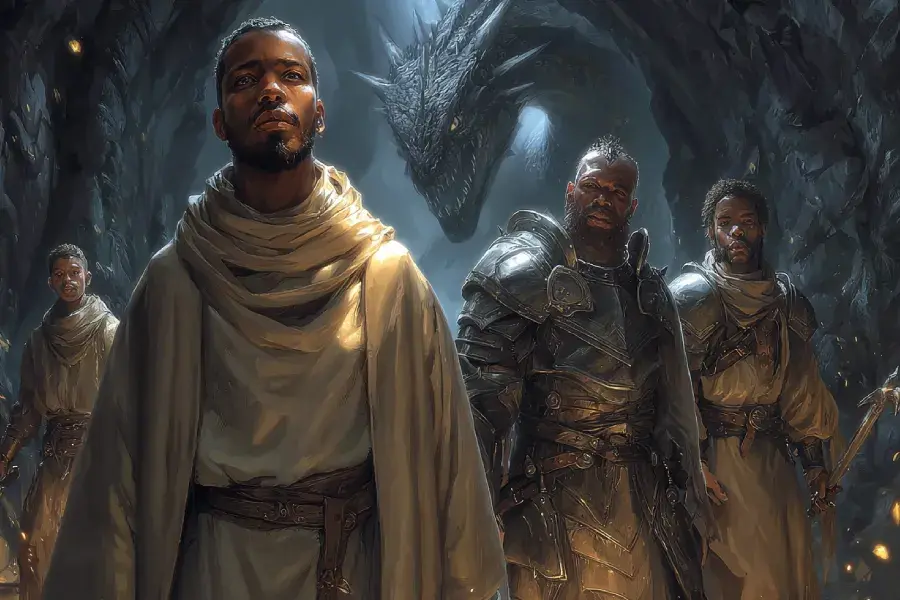
Imagine your character walking into a dragon's lair. The Fighter is clanking in heavy plate, every step echoing off the stone. The Paladin is polished to a mirror finish. But you? You’re wearing a simple silk robe or, perhaps, nothing but a loincloth and a grim expression.
There’s something undeniably cool about the warrior who doesn't need steel to survive. Whether it’s the serene Monk weaving through a storm of blades or the Barbarian whose skin is simply too tough for a sword to bite, Unarmored Defense 5e is one of the most iconic mechanics in Dungeons & Dragons.
But how does it actually work? Is it just a "flavor" choice, or can it keep you alive when the Ancient Red Dragon starts breathing fire? Whether you’re a new player trying to crunch the numbers or a veteran DM looking to give your unarmored heroes their moment in the sun, this guide is for you.

The Secret Logic: It’s a Replacement, Not a Bonus
The biggest mistake I see at the table is players trying to stack every defense they have. You’ve probably heard it before: "I’m a Barbarian, but I also have Mage Armor and a Monk level, so my AC is 25, right?"
Actually, no. It’s important to understand that your Armor Class (AC) is usually a calculation, not a pile of bonuses. By default, everyone has a base AC of 10 + their Dexterity modifier. When you gain a feature like Unarmored Defense, it gives you a new way to calculate that base.
Think of it like choosing which pair of shoes to wear. You can’t wear your hiking boots and your sneakers at the same time. If you have multiple ways to calculate your AC, you have to pick one. This keeps the game balanced and prevents numbers from spiraling out of control a concept the designers call "bounded accuracy".
The Heavy Hitters: Who is Unarmored Defense For?
In the standard 5e rules, two classes own this space, but the 2024 update has invited a few more guests to the party.
The Barbarian: Resilience Made Flesh
For a Barbarian, defense isn't about dodging; it's about being too tough to care. Their formula is 10 + Dexterity + Constitution.
What makes them the king of the frontline is that they are the only unarmored class allowed to use a shield and still keep the benefit. A Barbarian with a shield and decent stats can easily start the game with an AC of 16 or 17, which is just as good as a Fighter in chainmail.
The Monk: The Invisible Wall
Monks use their awareness to ensure they aren't where the blade lands. Their formula is 10 + Dexterity + Wisdom.
The catch? Monks are much more restricted. You can’t wear armor, and you definitely can't use a shield. This makes them "glass cannons" early on. You’ll rely on features like Patient Defense (using the Dodge action as a bonus action) to stay alive while you’re darting in and out of combat.
The New Class of 2024: Dance Bards and Draconic Sorcerers
The 2024 rules brought some massive changes.
College of Dance Bard: This is a brand new subclass that fights like a Monk but with the flair of a performer. Their AC is 10 + Dexterity + Charisma . Like the Monk, they can't use a shield.
The Revamped Draconic Sorcerer: In the old rules, their scales just gave them a flat 13 + Dexterity. Now, they use 10 + Dexterity + Charisma . The best part? They can technically use a shield if they find a way to get proficiency, making them surprisingly tanky casters.
Class | AC Calculation | Can Use Shield? | Key Stat |
Barbarian | 10 + Dex + Con | Yes | Constitution |
Monk | 10 + Dex + Wis | No | Wisdom |
Dance Bard | 10 + Dex + Cha | No | Charisma |
Draconic Sorcerer | 10 + Dex + Cha | Yes (with proficiency) | Charisma |
The 2024 Multiclassing Revolution
If you’re a veteran player, you remember the old "locked-in" rule. If you started as a Monk and took a Barbarian level, you were stuck with the Monk's version of Unarmored Defense forever.
Forget that! The 2024 rules have scrapped this restriction. Now, if you multiclass into different types of defense, you simply choose which calculation you want to use. This is huge for character builds, allowing you to pivot your defense strategy as your ability scores change .
Shortcuts to Success: The Best Species and Feats
Building an unarmored hero is a stat-hungry process. You need high Dexterity and a high secondary stat. This is called "Multi-Attribute Dependency" (MAD). To bypass the grind, look at these options:
S-Tier Species for Defense
The Tortle: Don't want to worry about stats? The Tortle has a natural shell that gives you a flat AC of 17. This is a game-changer for a "Strength Monk" who wants to dump Dexterity and Wisdom .
The Loxodon: These elephant-folk calculate their AC as 12 + Constitution . This is perfect for a Barbarian who wants to focus purely on health and hitting things hard without worrying about Dexterity.
Feats That Act Like Armor
Defensive Duelist (2024 Buff): This feat is basically a "Martial Shield spell." If you're holding a finesse weapon, you can use your reaction to add your Proficiency Bonus to your AC—and in the new rules, that bonus now lasts until the start of your next turn!
2024 Grappler: This is now a "must-pick" for Monks. It lets you deal damage and grapple a creature with a single attack, and you get advantage on attacks against anyone you’re grappling.
Tavern Brawler (2024 Update): Great for early-game unarmored builds. It lets you reroll 1s on your damage dice and gives you a free "push" when you hit with an unarmed strike.

Advice for Dungeon Masters: Make Their Choice Matter
As a DM, it’s your job to make the player feel like forgoing armor was a meaningful choice. Don't just look at the numbers; look at the narrative.
Use the "Squishy" Lure
Intelligent enemies don't usually attack the guy in the walking tank suit first. They look for the vulnerable target. An unarmored Barbarian looks "squishy," which can act as a natural taunt. Let the enemies charge the "easy target," only to realize too late that the Barbarian has 100 hit points and resistance to everything.
The "Gearless" Encounter
Every campaign should have one. A fancy gala where armor isn't allowed, or a prison break where the party is stripped of their gear.
In these moments, your Fighter is at an AC of 11.
Your Monk and Barbarian, however, are still at full power. This is the ultimate reward for their character build. It makes them feel like the heroes they are, regardless of what they're carrying.
Environmental Hazards
Armor is a liability in certain places. Remind your players of that!
Underwater: Swimming in heavy plate is a death sentence in many games.
Extreme Heat: Deserts and volcanoes are much easier to navigate when you aren't wearing a portable oven.
Heat Metal: There is no feeling quite like watching an unarmored character laugh while the Paladin is being cooked alive by a 2nd-level spell.
Key Takeaways for Your Next Session
Calculations don't stack: You can only use one base AC formula (e.g., Unarmored Defense or Mage Armor). Only bonuses (like a shield or Shield of Faith) add to that base.
2024 Freedom: You are no longer "locked in" to one type of defense when multiclassing. You pick the best one every time you finish a rest.
MADness is real: Unarmored builds need high stats. Use "half-feats" that give you a +1 to an ability score to keep your AC scaling .
DMs, reward the fantasy: Run prison breaks, social galas, and underwater fights where forgoing armor is a tactical masterstroke.
Ready to build your own unarmored legend?
The best part of D&D is that you don't have to follow the "optimal" path to have a blast. Sometimes, the most memorable hero is the one who survives by grit and grace alone.
Level up your character with the essential 5e rulebooks:
Master your class features with the Player's Handbook.
Expand your build with new feats in Xanathar's Guide to Everything.
Discover new species like the Tortle in Mordenkainen Presents: Monsters of the Multiverse.
(Note: The above are affiliate links that support the growth of the community.)
Does a Monk really need a shield when they can catch arrows out of the air? Probably not. By leaning into the strengths of these features, you aren't just building a stat block you're telling the story of a warrior who is their own best defense. Happy adventuring!


Comments