


Fireball 5e: The Veteran Wizard’s Manifesto
Pull up a stool, friend. Order a pint of the good stuff, the kind that hasn't been watered down by some apprentice’s Prestidigitation trick. You want to talk about the Big One, don't you? The spell that makes every goblin within sixty feet start rethinking their life choices right before they’re turned into a light dusting of carbon. We're talking about Fireball 5e.
Is there anything more satisfying than rolling a handful of d6s? That low roar as a tiny bead of bat guano and sulfur streaks across the battlefield before blossoming into a twenty-foot radius of pure, unadulterated "problem-solving"? It’s the quintessential evocation spell, the gold standard of the mid-game, and quite frankly, the reason your party’s fighter stays in your good graces. But if you’re going to be a master of the flame, you need to understand that this isn't just about throwing heat; it’s about tactical geometry, mathematical design, and knowing exactly when to keep that bead in your pocket.

The Math of the Blast: Why 8d6 is "Overpowered" by Design
Let’s address the elephant, or perhaps the red dragon in the room. If you look at the Dungeon Master’s Guide guidelines for spell creation, a 3rd-level spell that hits multiple targets is supposed to deal roughly $6d6$ damage. Yet, here we are, rolling $8d6$. Why the discrepancy?
The designers at Wizards of the Coast knew exactly what they were doing. They saw fireball (and to a lesser extent, Lightning Bolt) as integral to the culture and narrative of Dungeons & Dragons. It’s an iconic spell. They deliberately "overtuned" the damage to encourage players to pick it up, making it a benchmark for the power of a 5th-level character.
The Level 5 Power Spike
When a wizard reaches 5th level, the game shifts. This isn't an accident. The entire 5e power curve is built around the moment the wizard gets access to 3rd-level spell slots. To keep the rest of the party from feeling like mere spectators to your pyrotechnics, other classes received massive buffs at this same level:
Fighters, Paladins, and Rangers gain Extra Attack to keep their consistent damage relevant.
Rogues get Uncanny Dodge to survive the higher-lethality threats that now populate the board.
Monks gain Stunning Strike to provide the control that complements your raw damage.
Fireball deals an average of 28 damage on a failed save, which is enough to instantly incinerate a whole mob of CR 1/2 or CR 1 creatures. If you're targeting five enemies, you're looking at a total output of 140 damage in a single action. No other 3rd-level spell comes close to that instantaneous numerical impact.
Spell Level | Standard DMG Scaling | Fireball Actual | Average Damage (Fail) | Average Damage (Save) |
3rd Level | 6d6 | 8d6 | 28 | 14 |
4th Level | 7d6 | 9d6 | 31.5 | 15.75 |
5th Level | 8d6 | 10d6 | 35 | 17.5 |
6th Level | 9d6 | 11d6 | 38.5 | 19.25 |
As you can see from the table, upcasting fireball provides diminishing returns. Adding only 1d6 per spell level is a linear increase in a world where enemy hit points are growing exponentially. By the time you’re casting at 5th level, you’re often better off using a dedicated 5th-level spell like Cone of Cold, which starts at a higher baseline.
Tactical Placement: Mastering the 20-Foot Sphere
Throwing a fireball isn't just about distance; it’s about understanding the three-dimensional space of the battlefield. The spell creates a 20-foot-radius sphere centered on a point of your choosing within 150 feet. That’s a massive area of effect (AoE), covering approximately 1,256 square feet on a flat map.
The Grid Intersection Trick
If you’re playing on a grid, don't target a square. Target an intersection. By placing the point of origin at the corner where four squares meet, you ensure a perfectly symmetrical blast that minimizes arguments with the DM about whether a specific goblin is "mostly" in the radius. Under the standard Dungeon Master’s Guide rules (p. 251), if a circular effect covers at least 50% of a square, that square is affected.
The Vertical "Airburst"
Are your allies already in melee with the enemy? This is where the novice wizard incinerates the party rogue, and the veteran wizard earns a round of drinks. Remember, fireball is a sphere, not a circle. You can pick a point in the air 15 feet above the enemies’ heads.
Because the radius is 20 feet, an airburst at 15 feet will still catch medium-sized creatures on the ground but will significantly shrink the "shadow" of the blast on the floor. This allows you to tuck the edges of the explosion right up to your allies’ feet without actually touching them. It’s surgical, it’s stylish, and it keeps the rogue’s eyebrows intact.
Spreading Around Corners
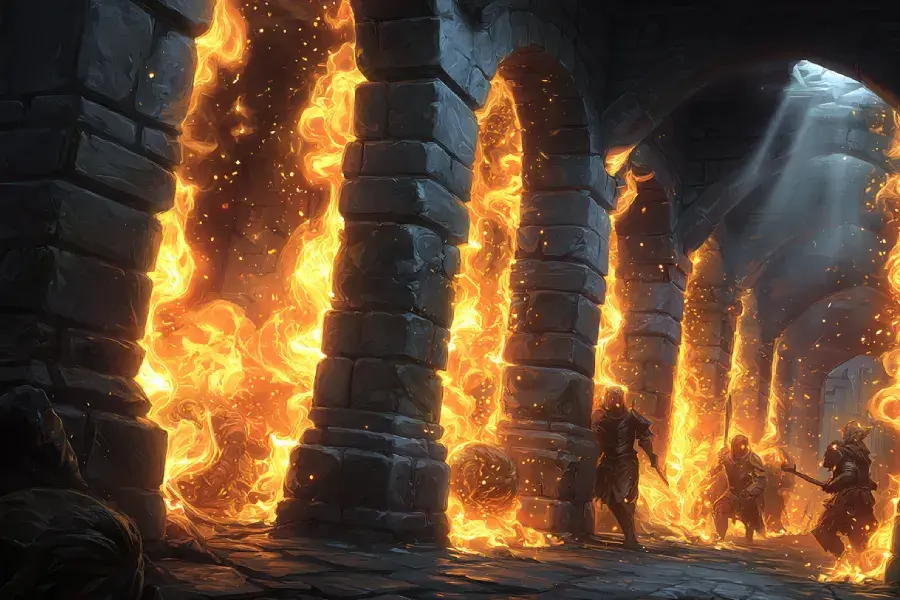
One of the most potent and often forgotten features of fireball is that the fire spreads around corners. This means that cover, unless it is total cover that completely seals off the target, is virtually useless. That goblin hiding behind a stone pillar? The fire wraps right around it. This makes fireball the ultimate "bunker buster" in dungeon corridors.

The "Fireball Problem": When to Keep the Bat Guano in the Pouch
Even the best spells have their limitations. If you rely solely on fireball, you're going to find yourself looking very silly when you meet your first group of devils.
The Resistance Hurdle
Fire is the second most commonly resisted damage type in the Monster Manual. Many iconic enemies are outright immune to your favorite trick. If you’re heading into the Nine Hells or a volcanic lair, fireball shouldn't be your opening move.
Damage Type | Resistant Monsters | Immune Monsters | Reliability Rank |
Fire | 85 | 65 | Low |
Lightning | 86 | 25 | Medium |
Cold | 113 | 29 | Medium |
Force | 0 | 1 | High |
Psychic | 3 | 18 | High |
Fiends (demons and devils) are the primary culprits here. Almost all devils are immune to fire, while many demons are resistant. If you see something with horns and a pitchfork, it’s time to check your other spell options.
The Counterspell Standoff
Fireball has a range of 150 feet, which is significantly longer than the 60-foot range of Counterspell. A smart wizard stays back. If you’re within 60 feet of an enemy mage, you're inviting them to snuff out your 3rd-level slot before it even leaves your finger. Use your range to your advantage. If you can see them but they can't reach you with their reaction, you win the trade.
Tight Spaces and Collateral Damage
In the old days, fireball had a "volume" rule. If you cast it in a space too small for its 33,500 cubic feet of fire, it would blow back and cook the caster. While 5e has removed the "blowback" mechanics, it hasn't removed the environmental consequences. Fireball ignites flammable objects that aren't being worn or carried. Casting this in a library, a dry forest, or on a wooden ship is a great way to turn a combat encounter into a "survive the building collapse" encounter.
Upcasting vs. Other Spells: Comparing the Toolbox
Is fireball always the right choice? Not by a long shot. At 5th level, your concentration is a precious resource, and fireball doesn't use it. This is both a strength and a weakness.
Fireball vs. Lightning Bolt
Both deal 8d6 damage. However, Lightning Bolt is a 100-foot line.
Pros of Lightning Bolt: Fewer things resist it. It’s easier to avoid allies if you’re positioned correctly. It works better underwater (fire damage is halved submerged).
Pros of Fireball: It covers 2.5 times the area. You can target it at a distance rather than it originating from you.

Fireball vs. Slow and Hypnotic Pattern
If you're fighting three giants, a fireball deals 28 damage each barely a scratch on their massive HP pools. Hypnotic Pattern, however, could incapacitate all three of them for the entire fight with one failed save.
Use Fireball for: "Mop-up duty." Clearing out groups of 10+ weaker enemies like goblins, skeletons, or guards.
Use Slow/Hypnotic Pattern for: "Encounter breaking." Controlling powerful foes that you can't kill in one or two rounds.
Fireball vs. Spirit Guardians
Clerics often claim Spirit Guardians is better. Mathematically, they have a point if the fight lasts more than three rounds.
Fireball is a burst of 28 damage.
Spirit Guardians deals 3d8 (avg 13.5) per round. By round three, the Cleric has dealt 40.5 damage to everyone in their radius.
However, Spirit Guardians requires the caster to stay in the thick of melee, while the wizard can fireball from two rooms away.
Feature | Fireball | Spirit Guardians | Slow |
Immediate Impact | Very High | Low | High (Control) |
Concentration | No | Yes | Yes |
Target Selection | Poor (AoE) | Excellent (Caster chooses) | Excellent (Caster chooses) |
Total Damage | High (Instant) | Extreme (Over time) | None |
Key Takeaways for the Aspiring Evoker
Know Your Math: Fireball is intentionally stronger than other 3rd-level spells to reward the wizard’s level 5 milestone.
Watch the Radius: Use intersections and verticality to avoid crispy-frying your allies.
Check the Resistance: Don't waste a slot on devils or fire elementals carry a backup like Lightning Bolt or Slow.
Mind the Library: Fireball ignites everything. If you're looking for a quiet, subtle solution, this isn't it.

Building the Better Blaster: Subclasses and Feats
Not all fireballs are created equal. Depending on your school of magic, your fireball might be safer, harder to resist, or even made of pure holy light.
The Evocation Wizard (The Gold Standard)
If you want to be the master of the "Broken Arrow" fireball, this is it.
Sculpt Spells (Level 2): You can choose a number of allies equal to 1 + Spell Level to automatically succeed on their save and take zero damage. You can finally drop a fireball centered on yourself and walk away without a singed hair.
Empowered Evocation (Level 10): You add your Intelligence modifier to the damage. It’s a small boost, but it makes your average damage more consistent.
Overchannel (Level 14): You can turn that 8d6 into a guaranteed 48 damage. No dice rolling required just pure, maximized destruction.
The Order of Scribes (The Specialist)
This is the thinking man’s pyromaniac. Their Awakened Spellbook allows you to swap the damage type of your spells. If you have Thunderstep in your book, your fireball can now deal thunder damage. If you have Vampiric Touch, it can deal necrotic damage. This allows you to ignore fire resistance entirely by simply changing the "flavor" of the explosion.
Essential Feats
Elemental Adept (Fire): This is non-negotiable for a fire-focused build. It allows you to ignore fire resistance (but not immunity) and treats any 1s you roll on the damage dice as 2s.
Metamagic Adept: Even if you aren't a Sorcerer, taking Transmuted Spell allows you to change a fireball’s damage type twice per long rest. It’s a life-saver when you run into a fire-immune boss.
DM Perspective: Handling the Fireball-Happy Player
As a DM, it can be frustrating when your carefully crafted encounter with ten low-HP minions gets vaporized in the first six seconds of combat. But don't punish the player for using a great spell. Instead, change the tactical landscape.
1. Spread the Enemies Out
A 20-foot radius is huge, but it isn't infinite. If you have enemies attacking from multiple directions or using skirmish tactics, the wizard can only hit two or three at once. Use the "V" formation or encircling tactics to force the wizard to prioritize their targets.
2. Use Verticality
Put archers on balconies or have flyers staying 30 feet above the ground. A wizard can fireball the ground or the air, but hitting both groups simultaneously becomes much more difficult.
3. The Objective-Based Combat
If the goal is to "Kill all the enemies," fireball is king. If the goal is to "Stop the ritual without killing the hostages" or "Recover the fragile crystal from the center of the room," the wizard has to be much more careful. Nothing stops a fireball faster than the threat of destroying the very thing the party is there to find.
4. Counterplay and Reactions
Don't just use Counterspell. Use enemies with Evasion (like monks or rogues) who take no damage on a successful save. Or use enemies with Fire Absorption (like iron golems) who are actually healed by the wizard’s favorite spell. It only takes one "I accidentally healed the boss for 30 HP" for a wizard to start diversifying their spellbook.
DM Strategy | Effect on Wizard | Why it Works |
Spacing | Reduces AoE efficiency | Forces resource management. |
Total Cover | Blocks line of effect | Highlights the "spread around corners" utility. |
Fire Resistance | Halves damage | Encourages the use of control spells. |
Hostages/Hazards | High risk of failure | Adds narrative tension to spellcasting. |
Is It Still the Best?
In the current meta of D&D 5e, is fireball still the undisputed champion of the 3rd-level slot? For raw, instantaneous damage against multiple targets, the answer is a resounding yes. It fulfills the fantasy of being a powerful wizard better than almost any other spell in the game.
However, a master wizard knows that a hammer isn't the right tool for every job. Fireball is your hammer a beautiful, glowing, 8d6 hammer. But sometimes, the battlefield needs a scalpel (like Mind Spike), a shield (like Slow), or a complete rewrite of the rules (like Hypnotic Pattern).
Use your fireball wisely. Use it to clear the path for your allies. Use it to make the DM sweat just a little bit. But most of all, use it because there is truly nothing like the silence that follows a perfectly placed explosion.
Now, if you’re ready to start filling your own spellbook, you’ll want to check out the Player’s Handbook for the core rules and Xanathar’s Guide to Everything for those sweet, sweet new spells and subclasses. Go forth, keep your guano dry, and try not to burn down the tavern on your way out.


Comments