
Mastering Environmental Hazards: Build Better Encounters in D&D 5e
- Mar 17
- 10 min read
Have you ever found yourself in the middle of a high-stakes battle, only to realize your players are standing in a featureless void, rolling dice until a number hits zero? It's a common affliction in the world of tabletop roleplaying, often referred to as "White Room Syndrome." This phenomenon occurs when a combat encounter lacks sensory detail, spatial grounding, and environmental interaction, leaving the participants feeling like they are floating in a sterile vacuum rather than engaging with a living, breathing world. For the Dungeon Master, the challenge is clear: how do we kill the white room? By integrating environmental hazards—ranging from treacherous terrain and flowing lava to the sudden peril of falling rocks—a DM can transform a mundane skirmish into a cinematic masterpiece. To build encounters 5e that truly resonate, one must understand that the setting is not just a backdrop; it’s a character in its own right.

Key Takeaways: Mastering the Environment
Concept | Actionable DM Tip | Expected Impact |
Sensory Grounding | Use the 5, 4, 3, 2, 1 technique (see, feel, hear, smell, taste) to anchor the scene. | Increased player immersion and narrative depth. |
Dynamic Hazards | Introduce environmental changes on Initiative Count 20 (e.g., rising water, spreading fire). | Prevents static "stand and swing" combat patterns. |
Telegraphed Danger | Mention a hazard three times before it triggers to ensure fairness. | Players feel challenged rather than "cheated" by traps. |
Forced Movement | Encourage classes to use abilities like Repelling Blast or Thorn Whip to interact with terrain. | Tactical depth and synergy between character builds. |
Severity Scaling | Use the DMG page 249 table to match hazard damage to party tier. | Credible threats that don't accidentally cause a TPK. |
The Theory of the Living Battlefield: Beyond the Grid
The "White Room" is more than just a lack of a physical map; it’s a failure of imagination where combatants are treated like "spherical, frictionless cows" in a physics experiment. In this vacuum, character builds are evaluated solely on raw damage output without the friction of the real world. But why settle for a sterile math problem when the environment can offer a journey of its own? Every room had a life before the characters entered it, and that history should inform the obstacles within. Whether it’s a high-end restaurant where the social hierarchy dictates the flow of battle or an unstable mine where every loud noise threatens a cave-in, the setting provides the tone and the conflict.
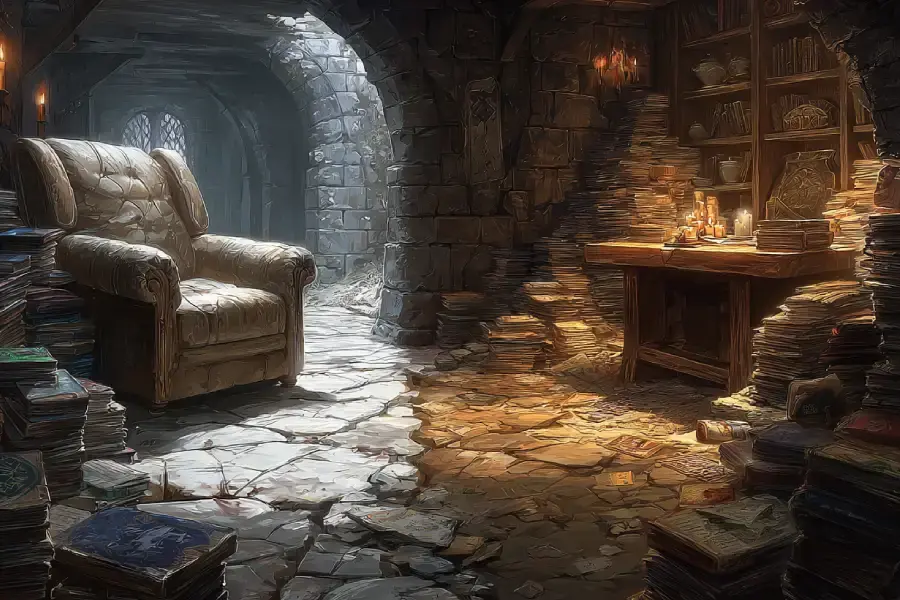
To effectively build encounters 5e, a DM must anchor the scene early. This means providing at least one sensory detail in the first few sentences of the engagement. Instead of merely stating "the room is small," a DM might describe how the character "squeezes between an overstuffed armchair and a heavy oak table, nearly knocking over a stack of yellowed magazines". This active language forces the players to visualize their space and move through it meaningfully. When a character slams a coffee cup on a marble counter and the sharp crack echoes through a silent kitchen, the environment is no longer a static image; it's a participant in the drama.
The Role of Sensory Detail in Combat Immersion
Readers and players alike need a mental picture to step inside the story. Without it, they remain observers rather than participants. Sensory details like the scent of rain, the creak of a floorboard, or the rough texture of a stone wall ground the experience. This grounding isn't just for flavor; it’s a critical component of Environment Battle tactics. Different characters will notice different things: a chef enters a kitchen and smells the spices, while a rogue notices the security of the windows. By filtering environmental details through the characters' perspectives, the DM reveals character traits while simultaneously building the battlefield.
The Mechanics of Environmental Hazards: Official 5e Frameworks
In the context of 5th Edition, an environmental hazard is any element of the terrain that can negatively impact characters through damage, conditions, or movement restriction. Unlike monsters, these hazards usually don't have hit points, but they can be just as deadly if not respected. To effectively implement these in a session, a DM must understand the principles of hazard creation: triggers, effects, severity, and detection.
Defining Hazard Severity and Scaling
The Dungeon Master’s Guide (DMG) provides a robust framework for improvising damage on the fly. This is essential when the party decides to do something unexpected, like pushing an enemy into a vat of acid or pulling a chandelier down on a group of guards. The damage should scale with the party's level to ensure the hazard remains relevant without becoming an insurmountable wall.
Character Level | Setback (d10s) | Dangerous (d10s) | Deadly (d10s) |
1st – 4th | 1d10 | 2d10 | 4d10 |
5th – 10th | 2d10 | 4d10 | 10d10 |
11th – 16th | 4d10 | 10d10 | 18d10 |
17th – 20th | 10d10 | 18d10 | 24d10 |
A "Setback" is unlikely to kill a character but serves as a resource drain. A "Dangerous" hazard poses a significant threat to a character already missing hit points. "Deadly" hazards are intended to drop a character to zero hit points or kill them outright. For example, being crushed by compacting walls or wading through a lava stream is a 10d10 event, which is deadly for a low-level party but a manageable danger for a high-level one.
Triggers and Detection
How does a hazard activate? It could be a specific action, like stepping into a marked zone or pulling a lever, or it could be a time-based event, such as a room slowly filling with poisonous gas. Detection is equally important; players should have a fair chance to notice the danger through Perception, Investigation, or Survival checks. If the ground trembles or a faint green mist seeps from the walls, the DM is providing the telegraphing necessary for the players to make meaningful tactical decisions.

Thermal Peril: The Mechanics of Lava and Fire
Lava is the ultimate "White Room" killer. It adds immediate stakes, forces movement, and creates high-drama moments. However, the adjudication of lava damage is often a point of contention among DMs. Is it "movie lava" or "realistic lava"? In the reality of physics, humans are much less dense than molten rock; a character wouldn't sink so much as they would float on the surface while instantly vaporizing. However, in D&D, we often favor the cinematic.
Adjudicating Lava Damage in 5e
The DMG page 249 specifies that "wading through" lava deals 10d10 fire damage per round, while "being submerged" deals 18d10. For a level 18 party, 18d10 is a terrifying prospect, potentially averaging 99 damage in a single round. This damage usually triggers both when a creature enters the lava and at the start of their turn, making it incredibly lethal.
Exposure Type | 5e Raw Damage | Average Damage | Narrative Consequence |
Brief Contact | 1d10 | 5.5 | Burning coals or a stray spark. |
Fire Pit | 2d10 | 11 | Stumbling into a campfire. |
Entering Lava | 6d10 | 33 | The heat blisters skin instantly. |
Wading | 10d10 | 55 | Molten rock melts boots and bone. |
Submerged | 18d10 | 99 | Disintegration and total destruction. |
Beyond raw damage, lava should be treated as difficult terrain. Even for creatures immune to fire, swimming in lava is nearly impossible due to its high viscosity—molten rock is roughly 100 times more viscous than motor oil. A dragon might dive into it, but its orifices would be clogged by cooling rock, and it would need a Strength of 30 just to maneuver. This mechanical depth discourages players from simply treating lava as "red water" and forces them to use DM Tips like the Water Walk spell to survive the radiant heat.
Gravity as a Weapon: Falling Rocks and Verticality
If lava is the floor’s way of saying "move," then falling objects are the ceiling’s way of saying "look up." Falling damage is a staple of 5e, dealing 1d6 bludgeoning damage for every 10 feet fallen, up to a maximum of 20d6. While simple, this mechanic becomes a powerful tool for building dynamic Environment Battle scenarios.
Falling Objects and Impact Math
When a character or an enemy is hit by a falling object, the damage is traditionally calculated based on the weight of the object and the height of the fall. A common house rule suggests that for objects weighing 200 pounds or more, the damage is 1d6 per 10 feet of the fall, mirroring the damage taken by a falling creature.
Object Weight | Damage per 10ft | Maximum Damage |
200+ lbs | 1d6 | 20d6 |
100-199 lbs | 1d6 (per 20ft) | 1d6 |
50-99 lbs | 1d6 (per 30ft) | 5d6 |
1-4 lbs | 1d6 (per 70ft) | 1d6 |
This creates a "high ground" advantage that goes beyond narrative fluff. A warlock on a 30-foot platform can use Repelling Blast to knock an enemy backward into open air, adding 3d6 falling damage and bringing the creature down to the ground where melee fighters can engage it. This interaction between verticality and forced movement is a key strategy for DMs looking to spice up combat. If a barbarian dives off a cliff while grappling a wizard, they might survive the fall thanks to their high HP and Rage resistance, while the wizard takes the full 1d6 per 10 feet—a tactic often called the "suplex".
The Mechanics of the Instant Fall
In 5e, falling is usually instantaneous. A creature drops up to 500 feet in the turn the fall begins. This makes reactions like Feather Fall or a monk’s Slow Fall essential. For a DM, this means that any combat near a ledge is inherently more dangerous because a single shove can remove a combatant from the field for multiple rounds or end their life entirely.

Atmospheric Hazards: Wind, Smoke, and Visibility
Not every hazard needs to deal direct damage to be effective. Sometimes, the most frustrating (and thus tactically interesting) obstacles are those that obscure vision or impede movement. These are the elements that turn a standard room into a Maps D&D challenge.
Smoke and Fire Spread
A fire in an enclosed space is more than just a heat source; it’s a factory for smoke. In some mechanical systems, ignited objects produce smoke that grows by 5 feet in radius per round. Ending a turn in smoke might require a Constitution save to avoid coughing, which can disrupt spellcasters attempting to use verbal components. Fire itself can be dynamic, growing 1 to 4 squares in random directions each round depending on wind and fuel sources.
The Chaos of Weather and Wind
In an outdoor Environment Battle, weather is a constant factor. High winds might impose disadvantage on ranged weapon attacks or Perception checks. If it's raining, everything becomes slippery, perhaps requiring a DC 10 Dexterity (Acrobatics) check every round to avoid falling prone. These conditions force players to adapt; a wizard might cast Fog Cloud not to hide, but to cancel out the advantage of a creature with Darkvision, leveling the playing field for the party.
Hazard | Mechanical Effect | Tactical Implication |
Dense Fog | Heavily Obscured | Attacks are made at neutral (Adv/Dis cancel). |
Slippery Ice | Difficult Terrain + DC 10 Save | High risk of falling prone; reduces melee effectiveness. |
Raging River | Strength (Athletics) Check | Potential to be swept away; separates the party. |
Strong Wind | Disadvantage on Ranged | Forces combat into close quarters. |

Class Synergies: How Players Use the Environment
A great encounter isn't just about what the DM does to the players; it's about what the players can do to the world. When you Build Encounters 5e, you should provide "toys" for the players to play with.
The Warlock: The Master of the Push
The Repelling Blast invocation is arguably the most powerful environmental tool in the game. It allows a warlock to push a creature 10 feet away with every hit of Eldritch Blast. Because there is no size limitation or saving throw, a high-level warlock can push even a Gargantuan dragon 30 or 40 feet back. A clever warlock will position themselves to push enemies into Spike Growth, Wall of Fire, or off the edge of a 10,000-foot drop.
The Druid: The Pull and the Grater
Druids excel at pulling enemies into danger. The Thorn Whip cantrip pulls a Large or smaller creature 10 feet closer. When combined with Spike Growth, the druid can drag an enemy through the spikes, dealing massive damage without ever making a weapon attack. This "forced movement" is not affected by difficult terrain, meaning the enemy takes the full damage of the spikes as they are dragged.
The Monk: Parkour and Positioning
Monks are the kings of the interactive battlefield. Their Slow Fall ability, which reduces falling damage by five times their monk level, allows them to treat cliffs as elevators. In the 2024 rules, monks can use their high mobility to grab an enemy wizard and drag them 80 feet across the map into a hazardous zone, or simply run up a wall to engage archers on a rooftop. DMs can "throw a bone" to monks by including projectile traps or high ledges that allow them to use their unique reaction and movement options.
DM Tips: Designing and Telegraphing the Map
How do we practically bring these elements to the table? It starts with the map. Whether you use a Virtual Tabletop (VTT) or a paper map, the key is "clutter".
The Art of the Dynamic Map
A dynamic environment is anything on the map that can or will change during the encounter. This could be a sinking ship, a collapsing bridge, or a room that is slowly flooding. To make these work, you need to show, not tell. Describe the coils of rope, the barrels of oil, or the rickety chandelier.
Use Separate Tokens: In a VTT, keep objects like tables, statues, and carts as separate tokens. This allows players to move them for cover or knock them over as barriers.
Verticality: Use Jenga blocks or foam boulders on a physical map to represent different heights. If you're using theater of the mind, explicitly state the height of ledges and the presence of "murder holes" or skylights.
Alternate Win Conditions: Combat doesn't always have to be about killing everything. Maybe the environment provides the win condition—stopping a ritual before a timer hits zero, or escaping a collapsing ruin.
Telegraphing: The Secret to Fairness
None of your threats work if the players can't read them. Telegraphing should be subtle but consistent. The ground shaking, scorch marks on the stone, or the faint smell of decay all frame the danger. If a monster has a poisonous breath weapon, have the locals whisper about the "fetid gas" that blankets the fields. When players see a room that "appears empty" after these warnings, they will be rightfully suspicious and engage with the environment more carefully.
Balancing the Equation: CR and Encounter Difficulty
When you add environmental hazards, the math of the encounter changes. A group of kobolds is a nuisance; a group of kobolds in a room full of pit traps and narrow tunnels they can squeeze through is a nightmare.
Adjusting for Environmental Advantage
If an environment heavily favors one side, you should adjust the difficulty accordingly. For example, giving zombies ringmail to boost their AC from 8 to 14 changes their CR and can turn a "Medium" encounter into a "Deadly" one. Similarly, placing a vampire in a room with high ceilings and pillars allows them to use their Spider Climb ability effectively, increasing their survivability and threat level.
The Action Economy of Hazards
Hazards often act as additional "combatants" in the action economy. A rolling boulder that moves 30 feet every round or a geyser that erupts at the end of each turn is essentially a monster that cannot be killed. To keep the battle fair, you might reduce the number of minor enemies (minions) to compensate for the resources the players must spend dealing with the environment.
Conclusion: Killing the White Room Forever
Building encounters 5e that are memorable and tactical requires a shift in mindset. We must stop viewing the map as a static image and start seeing it as a living part of the game’s mechanics. Whether it's the sheer terror of falling into 18d10 lava or the simple tactical joy of a monk dragging an enemy into a puddle of acid, the environment provides the friction that makes combat meaningful. By grounding our descriptions in the five senses and providing interactive "toys" for our players, we kill the white room and replace it with a world of endless possibility.


Comments